

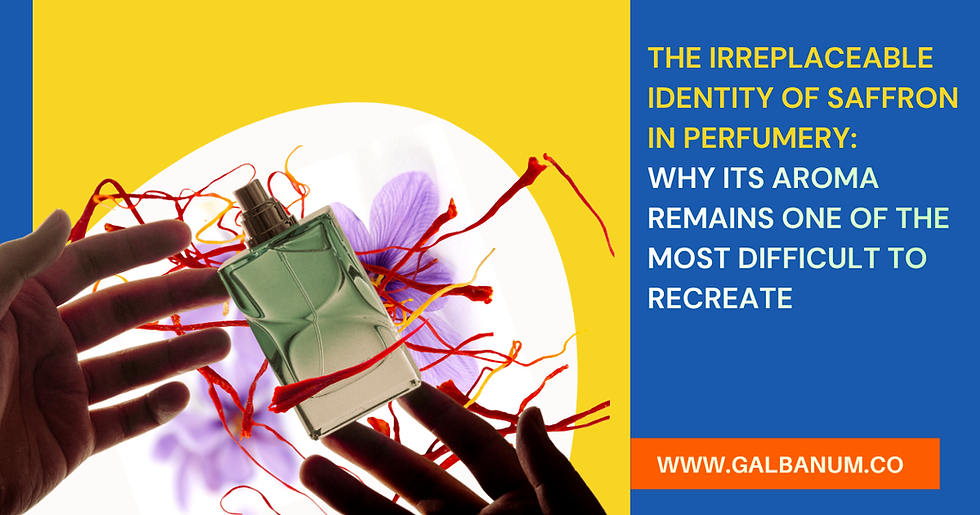
The Irreplaceable Identity of Saffron in Perfumery: Why Its Aroma Remains One of the Most Difficult to Recreate

Introduction
Among the world’s most treasured natural materials, saffron (Crocus sativus L.) holds a unique position in both cultural history and modern perfumery. Known as the most valuable spice by weight, saffron represents far more than rarity and luxury. In fragrance creation, it is valued for something much deeper: an extraordinary aromatic identity that combines warmth, elegance, texture, and complexity.
Despite major advances in fragrance chemistry and the development of sophisticated aroma molecules, creating a complete reproduction of natural saffron remains one of the most challenging tasks in modern perfumery.
The reason is not simply that saffron has a distinctive smell. The true challenge lies in its complex chemical composition and the way hundreds of subtle interactions create a constantly evolving olfactory experience.
Unlike a single aroma molecule that produces one recognizable effect, saffron reveals multiple dimensions throughout fragrance evaporation—making it one of the most fascinating and difficult materials to fully imitate.
Saffron Is More Than a Spicy Note
Saffron is often described as a warm spice, but this description only captures a small part of its true olfactory character.
Depending on concentration, extraction method, and the surrounding fragrance composition, saffron can express:
Warm leathery nuances
Soft suede-like textures
Dry hay and earthy facets
Metallic brightness
Honeyed sweetness
Mineral freshness
Subtle floral impressions
Slight medicinal and aromatic undertones
Unlike materials such as cinnamon, clove, or cardamom, which are often recognized through a dominant aromatic signature, saffron creates a more fluid sensory impression. Its character changes as the fragrance develops on skin, revealing different layers over time.
For this reason, professional perfumers often view saffron not merely as a note, but as a structural ingredient capable of influencing the entire architecture of a fragrance.
The Chemistry Behind Saffron’s Unique Aroma
The complexity of saffron comes from its extraordinary chemical composition.
One of the most important aroma-active compounds in saffron is safranal, a volatile molecule largely responsible for its characteristic warm, spicy, and slightly leathery odor.
However, saffron’s identity cannot be explained by safranal alone.
The complete aroma profile results from the interaction of multiple compounds, including:
Safranal and related volatile aldehydes
Picrocrocin-derived aroma compounds
Carotenoid degradation products
Terpenoid constituents
Fatty acid derivatives
Trace aromatic molecules
Although some of these compounds exist only in very small quantities, they can strongly influence fragrance perception. In natural materials, minor molecules often play a major role in creating depth, diffusion, and emotional impact.
This principle is fundamental in perfumery: the importance of an aroma molecule is not determined only by its concentration, but by its sensory contribution.
Why Synthetic Molecules Cannot Fully Reproduce Natural Saffron
Modern fragrance chemistry has created several materials capable of capturing important aspects of saffron.
Among them, Safraleine® and other saffron-inspired aroma chemicals are widely appreciated by perfumers for their ability to provide warm spicy, leathery, and metallic effects.
However, these materials do not reproduce natural saffron itself.
Instead, they recreate selected facets of saffron’s identity.
A single synthetic molecule usually represents one specific dimension:
leather warmth,
spicy dryness,
metallic brightness,
or amber-like richness.
Natural saffron, however, behaves differently. During evaporation, it gradually reveals changing layers, moving between spice, leather, floral softness, and mineral freshness.
This multi-dimensional evolution is what makes natural saffron difficult to completely recreate.
For this reason, perfumers typically build saffron accords by combining several materials rather than relying on one single ingredient.

The Art and Science of Creating a Saffron Accord
A convincing saffron accord is one of the most sophisticated exercises in fragrance formulation.
The goal is not always to copy saffron literally. Instead, perfumers aim to recreate the sensation and emotional impression associated with this precious material.
A modern saffron accord may include:
leather and suede molecules,
warm amber materials,
woody notes,
spicy aldehydes,
floral ingredients,
musks,
mineral and metallic effects.
The balance between these elements determines whether saffron appears luxurious, sensual, mysterious, clean, oriental, or contemporary.
Because every perfume house interprets saffron differently, this ingredient has become one of the most creative materials in modern niche perfumery.
Why Natural Saffron Extract Is Rare in Fine Fragrance
Although saffron is highly valued in perfumery, true natural saffron extracts remain relatively uncommon.
Several factors contribute to this:
Extremely Low Yield
Thousands of saffron flowers are required to produce a small amount of spice, making the raw material exceptionally precious.
Extraction Challenges
The aromatic molecules of saffron are delicate, and maintaining its original olfactory character during extraction requires advanced techniques.
Chemical Variation
The aroma profile of saffron can vary depending on:
geographic origin,
cultivation conditions,
harvesting methods,
drying processes.
This natural variation creates both beauty and complexity, but it also makes standardization difficult for large-scale fragrance production.
Why Saffron and Leather Create a Perfect Olfactory Partnership
One of saffron’s most iconic combinations in perfumery is leather.
This relationship is not accidental. Both materials share overlapping sensory characteristics:
warmth,
dryness,
elegance,
subtle smokiness,
tactile richness.
Saffron softens the sharper edges of leather accords, adding brightness and refinement. At the same time, leather enhances saffron’s darker and more luxurious aspects.
This synergy explains why saffron frequently appears in modern niche fragrances alongside:
leather,
oud,
amber,
woods,
rose.
Together, these materials create some of the most recognizable luxury fragrance signatures of recent decades.
Saffron Creates Texture, Not Only Aroma
One of saffron’s most remarkable qualities is its ability to create the illusion of texture.
Experienced perfumers often describe fragrance through tactile language:
velvet,
silk,
softness,
smoothness,
polished warmth.
Saffron contributes strongly to these sensations.
Even in very small amounts, it can make a composition feel richer, deeper, and more refined.
This textural effect is one reason saffron remains highly desirable in luxury perfumery despite its subtle aromatic intensity.
The Luxury Symbolism of Saffron in Fragrance Culture
The value of saffron in perfumery is not based only on chemistry. It is also connected to centuries of cultural symbolism.
Across Persia, India, the Mediterranean, and the Middle East, saffron has represented:
refinement,
prosperity,
celebration,
craftsmanship,
prestige.
This historical association influences modern fragrance perception. When consumers encounter saffron in a perfume, they often connect it with rarity, exclusivity, and traditional luxury.
Modern perfume houses continue to use this powerful symbolic identity to create fragrances that feel timeless and sophisticated.
The Future of Saffron in Modern Perfumery
Future developments in biotechnology, analytical chemistry, and artificial intelligence may provide deeper understanding of saffron’s aromatic structure.
Advanced analytical methods such as gas chromatography–mass spectrometry (GC-MS) continue to reveal new information about natural materials and their odor-active molecules.
However, fully reproducing saffron’s complete olfactory identity remains a remarkable challenge.
Like natural rose, oud, and other complex botanical materials, saffron derives its beauty from the interaction of many compounds working together.
Its complexity is exactly what makes it valuable.
Conclusion
Saffron is not simply a luxurious spice used as a perfume note. It is one of nature’s most sophisticated aromatic materials.
Its evolving character, remarkable textural effects, and complex chemistry make it one of the most challenging ingredients to fully reproduce.
For perfumers, saffron represents more than an aroma—it is a creative instrument capable of adding depth, emotion, and elegance to a fragrance composition.
As fragrance science continues to advance, saffron will remain one of perfumery’s most treasured materials, not only because of its rarity, but because of its unique and irreplaceable aromatic identity.
This article was researched and written by Galbanum Oil Fragrance
The use of this article is permitted by citing the source.
📩 Get in Touch
📧 Email: info@Galbanum.co
🌐 Website: www.galbanum.co
Location: Cevizli, Tugay Yolu Cd. 69-C, 34846 Maltepe/İstanbul


Comments